
Sovereign AI · August 28, 2026
vLLM 0.28 raises the bar for private inference
vLLM 0.28.0 landed on 26 August 2026 with a dense set of inference-engine changes: Kimi-K3 optimisation work, DeepSeek V4 sparse MLA support, Model Runner V2 maturation, tiered KV cache offload, Rust/gRPC frontend work, updated defaults, and new release artifacts across CUDA, ROCm, CPU and XPU builds. On paper, this is exactly the kind of release sovereign AI teams want: more model coverage, better GPU utilisation, and a clearer path to high-throughput private inference without sending regulated data to an external API.
For Luxembourg and European financial institutions, the message is not simply “upgrade vLLM”. The message is that private inference has become a production control plane. If a fund administrator, AIFM, private bank or RegTech provider uses local LLMs for ticket triage, document search, operational runbooks, alert enrichment or developer automation, the inference layer now sits close to regulated workflows. That makes vLLM versioning, model compatibility, GPU scheduling, prompt routing and observability part of the same operational-resilience conversation as Kubernetes, reverse proxies, identity, logging and incident response.
Regulatory & Business Impact
The business case for vLLM remains strong. Private inference can reduce recurring API exposure, improve latency for internal tools, and keep sensitive operational context inside controlled infrastructure. In a European financial environment, that matters. A model summarising payment incidents, classifying client onboarding documents, inspecting fund operations exceptions or helping an SRE interpret production telemetry may touch personal data, confidential business information or operational-security details. Under GDPR, DORA and the EU AI Act, that is not a casual engineering experiment.
vLLM 0.28.0 also shows why executive teams should treat open-source AI infrastructure as a governed platform, not a library update. The release notes list performance-oriented changes such as Decode Context Parallel support, fused FlashKDA kernels, combined all-gather optimisation, adaptive speculative token budgets, and shared-expert sharding. Those are valuable when GPU budgets are under pressure. If a bank can serve the same workload on fewer H100s, MI300-class systems, or mixed internal hardware, the ROI is direct: lower capex pressure, better utilisation, and less temptation to bypass governance through unmanaged SaaS tools.
But there is an operational-risk side. Public GitHub issues opened against v0.28.0 already include reports of prefix caching with MTP producing malformed responses on a hybrid Mamba/GDN model, and a separate report of distributed DeepSeek-V4-Pro inference hanging during multi-node startup. These are not proof that the release is broadly unsafe. They are proof that AI inference engines now have the same release-risk profile as databases, hypervisors and Kubernetes control planes. Correctness, startup behaviour, cache strategy and distributed execution must be tested against your models and your workload — not only against vendor benchmarks.
For DORA-era organisations, this matters because an AI assistant connected to production operations can amplify mistakes. A corrupted answer in a chatbot is annoying. A corrupted answer inside an incident workflow, access review, change advisory or payment-platform triage process can become an operational-risk event. The compliance question is no longer “where is the model hosted?” It is also “how do you prove that the model-serving path is versioned, tested, monitored, recoverable and constrained?”
Architectural & Operational Blueprint
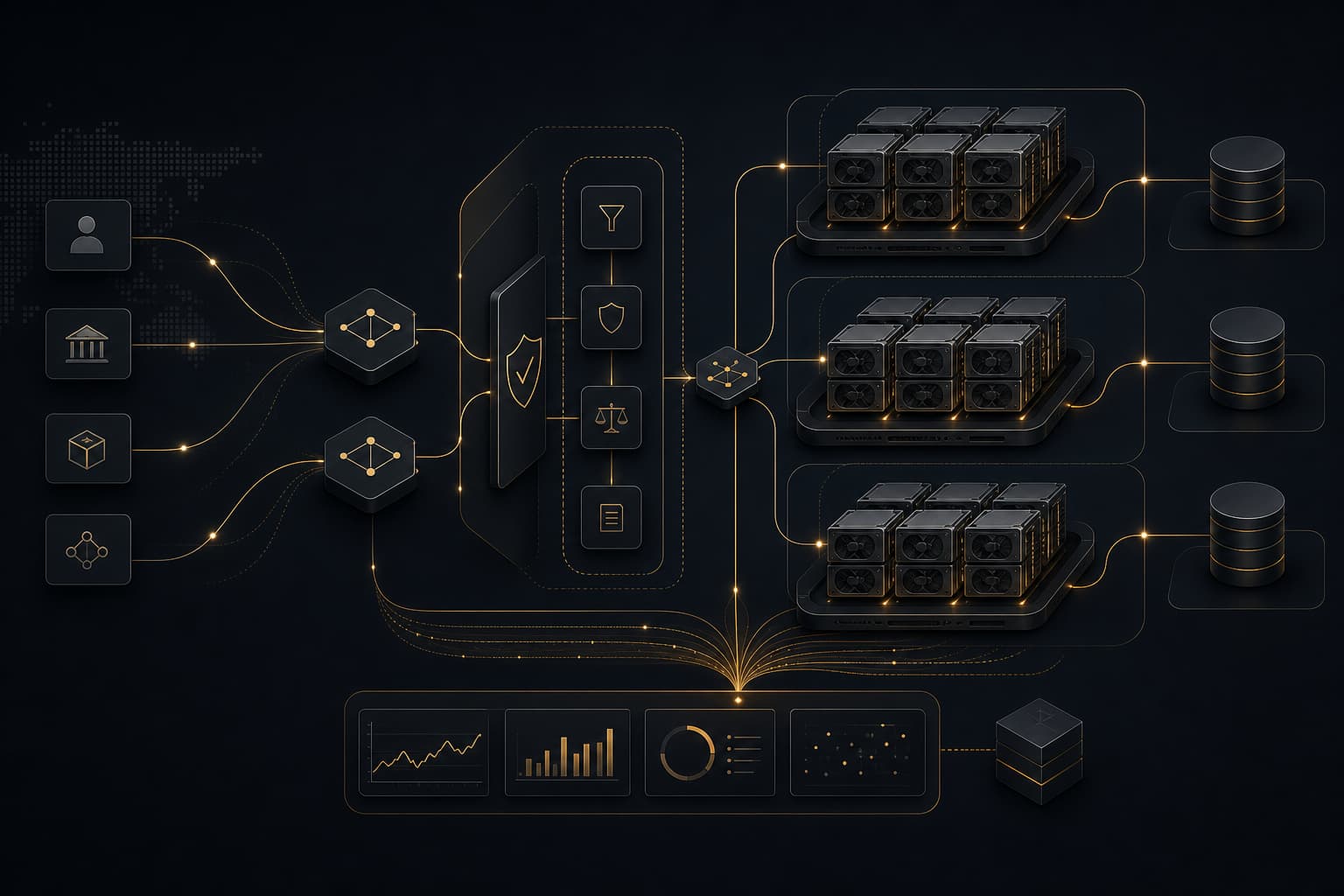
A credible private-inference architecture starts with separation of concerns. vLLM should not be exposed as an unmediated internal endpoint where every tool, agent and analyst can send arbitrary traffic. Put it behind a controlled ingress layer: Nginx, F5, HAProxy or an API gateway with mTLS, identity-aware routing, request limits and clear network segmentation. If the model endpoint becomes a shared infrastructure service, treat it like one.
The next layer is model and runtime governance. Pin the vLLM container image, CUDA or ROCm runtime, model revision, tokenizer, quantisation format and startup parameters in Git. Store them as code, review them like infrastructure, and promote them through environments. A change from one vLLM minor release to another should trigger a test matrix: model load, first-token latency, throughput, structured-output validity, tool-call parsing, refusal behaviour, cache hit correctness, multi-node startup and failure recovery.
For GPU clusters, Kubernetes can help, but it is not magic. Use node labels for GPU generation, topology-aware scheduling where available, taints for inference nodes, and dedicated namespaces for AI workloads. If you run vLLM on bare metal or Proxmox-backed GPU nodes, keep the same discipline: immutable deployment scripts, Ansible-managed configuration, known-good driver stacks, and controlled rollback. The operational goal is simple: if v0.28 improves throughput but breaks one production-critical model, you must be able to revert in minutes, not rebuild the platform over a weekend.
Observability is non-negotiable. At minimum, collect GPU utilisation, memory pressure, request latency, queue depth, token throughput, error rates, model-load events, process restarts and upstream gateway metrics. Zabbix or Prometheus can cover platform health; Grafana gives the operational view; OpenTelemetry can tie model calls back to workflow executions where appropriate. For regulated workflows, log metadata and decisions carefully, but avoid storing prompts containing sensitive data unless there is a clear retention policy and access model.
The architecture should also include an agent boundary. If LangGraph, MCP tools, internal scripts or ticketing integrations call vLLM, define what the agent may read, what it may write, and where human approval is mandatory. Vector search through Qdrant or another local database should use scoped collections, not one large uncontrolled knowledge lake. An AI assistant that can retrieve runbooks is useful. An AI assistant that can retrieve secrets, client files and privileged incident notes because all embeddings were mixed together is a governance failure.
What This Changes in Practice
- Promote vLLM through release gates. Treat v0.28.0 as a platform upgrade requiring staging, load testing and rollback, not a routine Python package bump.
- Test correctness, not only speed. Validate structured outputs, tool-call JSON, RAG citations, repeated-prefix workloads and deterministic prompts before production rollout.
- Separate inference from orchestration. Keep vLLM as the serving layer; put policy, approvals, workflow state and audit trails in the orchestration layer.
- Pin everything. Container image, model revision, tokenizer, GPU driver, CUDA/ROCm runtime, quantisation format and startup flags should be reproducible.
- Watch cache-related behaviour. Prefix caching and speculative decoding are attractive for cost and latency, but they must be validated for each model family.
- Design for sovereign operations. Keep regulated prompts, embeddings and telemetry in controlled EU infrastructure unless a documented exception exists.
- Build evidence for DORA. Dashboards are not enough. Keep deployment records, test results, change approvals, incident timelines and rollback evidence.
How Ali Run AIOps Approaches This
Ali Run AIOps approaches private inference as infrastructure engineering first and AI experimentation second. The work starts with resilient Linux and network foundations: GPU nodes, reverse proxies, TLS, identity boundaries, storage, monitoring and automated recovery. Then we add the AI layer — vLLM or Ollama for local serving, Qdrant for vector retrieval, LangGraph for controlled agent flows, and Ansible for repeatable deployment and remediation.
For financial and regulated enterprise clients, the objective is not to chase every model release. It is to build a sovereign AI operating model that can pass scrutiny: where data stays, who can call the model, how changes are approved, how incidents are detected, and how the business recovers when an inference component misbehaves. vLLM 0.28.0 is a useful release. The winning teams will be the ones that turn it into a governed platform, not another unmanaged endpoint.
Sources
- vLLM 0.28.0 changelog and release notes via What’s New
- vLLM project release dashboard on release.bar
- GitHub issue: prefix caching and MTP malformed output report in vLLM 0.28.0
- GitHub issue: distributed DeepSeek-V4-Pro startup hang report in vLLM 0.28.0
- European Commission: guidelines for providers of general-purpose AI models
Related Notes
Sovereign AI · Sep 7, 2026
Luxembourg Open-Source AI Assessment Sandbox Configurator
Luxembourg's LIST and SnT release an open-source sandbox configurator to standardize EU AI Act and DORA compliance testing for enterprise AI.
Sovereign AI · Sep 2, 2026
Frontier AI privacy moves into customer custody
Anthropic’s new safeguards make frontier AI a custody architecture problem for regulated European firms, not just a vendor policy choice.