
Sovereign AI · September 2, 2026
Frontier AI privacy moves into customer custody
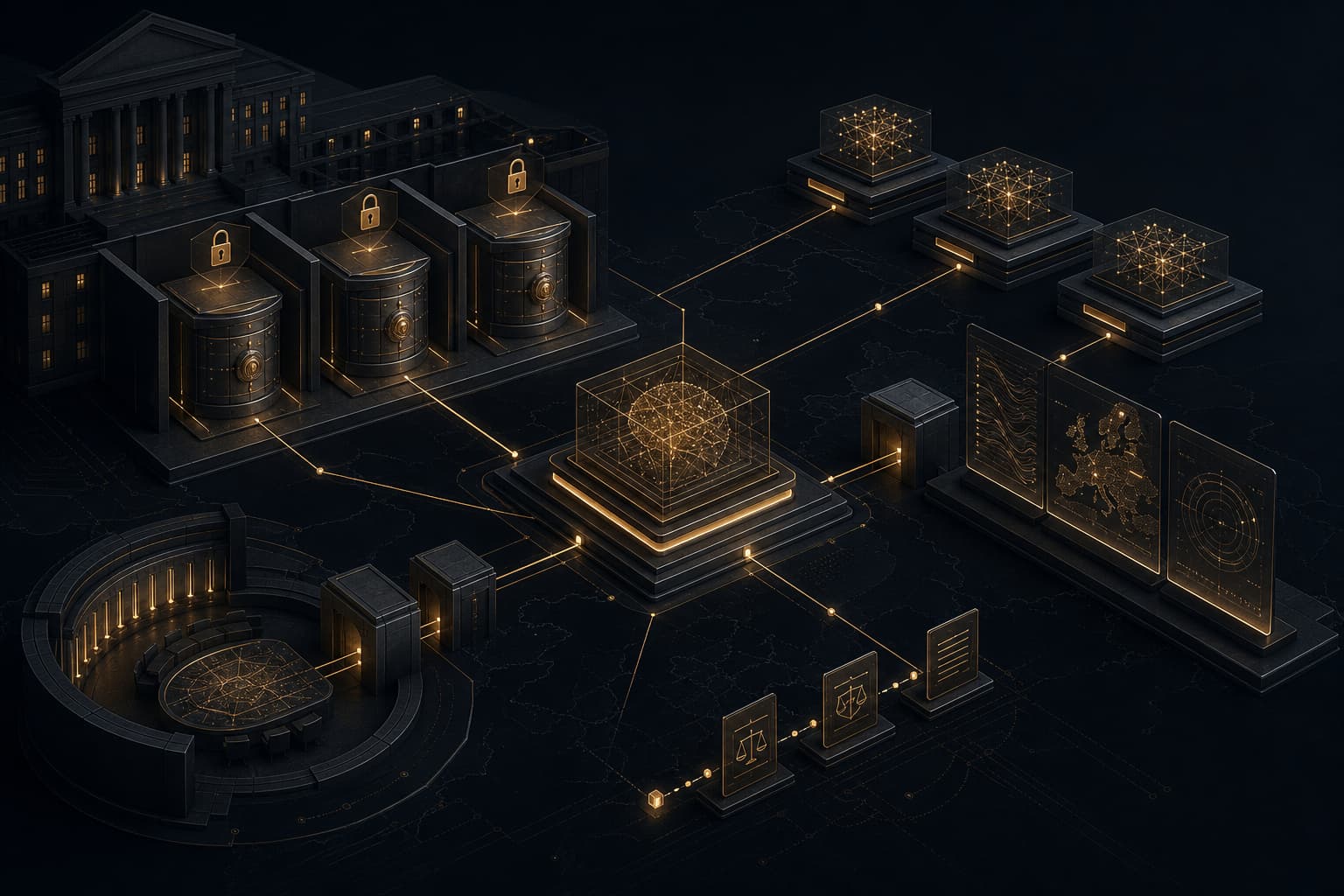
On 1 September 2026, Anthropic announced Enterprise Frontier Safeguards, a new architecture intended to let eligible enterprise customers use its most capable Claude Fable models while keeping monitoring data in customer-controlled cloud infrastructure. The same day, AWS announced Claude Fable 5.1 availability on Amazon Bedrock and described how the new retention and safeguard model works inside the AWS boundary. Axios framed the move correctly: this is not only a model release; it is a response to enterprise privacy, cost, and safety objections around frontier AI deployment.
For Luxembourg and European financial institutions, the important signal is not the model name. It is the custody pattern. Frontier AI is moving from a simple API procurement question into a regulated control-plane design: who stores prompts and outputs, who holds encryption keys, who reviews safety alerts, how long evidence is retained, and how the arrangement is documented for DORA, GDPR, EU AI Act, internal risk committees, and external auditors. In fund operations, private banking, risk systems, and RegTech workflows, that distinction matters more than another benchmark table.
Regulatory & Business Impact
Anthropic’s policy for covered models confirms a hard reality for regulated AI adoption: higher-capability models may require retained usage data for misuse detection. Anthropic says covered models are designated when their capabilities create elevated misuse risk, and that Claude Fable 5.1 is generally available but subject to covered-model policies. By default, covered-model use involves a retained window of prompts and completions. Anthropic’s new EFS proposal tries to resolve the conflict by moving activity data into infrastructure controlled by the customer, with customer-managed encryption keys, access policies, audit logging, and automated monitoring.
That architecture is highly relevant for European financial entities because it maps directly onto the language of operational resilience. DORA does not allow a bank, AIFM, payment firm, or critical fund service provider to treat an AI platform as an informal productivity tool once it supports important business processes. If a frontier model reads incident notes, drafts code for production systems, reviews firewall changes, analyses AML workflows, or queries operational documents, it becomes part of the ICT risk landscape. The EBA’s DORA material on registers of information and ICT third-party risk reinforces the same principle: contractual arrangements and critical dependencies must be visible, assessed, and governable.
The EU AI Act adds another layer. Article 50 transparency obligations have applied from 2 August 2026, and the Commission has positioned codes and guidelines as practical compliance tools for providers and deployers of certain AI systems. For enterprise leaders, the immediate operational issue is not only whether generated content is labelled. It is whether the organisation can reconstruct the path from input data, model selection, tool invocation, human approval, output distribution, and retention decision. If that chain is missing, compliance becomes a meeting-room assertion rather than an evidence-backed control.
AWS’s Bedrock announcement is especially notable because it describes a platform implementation rather than a generic privacy promise. AWS says Claude Fable 5.1 requires an AWS review retention mode by default, with prompts and outputs retained within the AWS boundary and not shared with the model provider. For EFS-eligible customers, AWS says zero data retention is available for internal use through 31 December 2026, and future EFS controls are expected to keep prompts and outputs in the customer’s AWS account under the customer’s encryption keys, access policies, and audit logging.
My analysis: this will influence European AI procurement. Boards and CIOs will increasingly ask whether a model provider offers three separate things: strong capability, strong misuse monitoring, and customer custody of sensitive telemetry. Providers that cannot answer all three will struggle in regulated workloads, even if their model quality is excellent.
Architectural & Operational Blueprint
The right design pattern is an AI control plane, not a direct model API scattered across engineering teams.
Start with a governed ingress layer. In practical terms, that means an internal AI gateway behind existing enterprise controls: F5, Nginx, API Gateway, or a service mesh depending on the estate. Every request should be authenticated against enterprise identity, tagged with application, user, business function, risk tier, data classification, and approved model route. A prompt from a developer refactoring Terraform is not the same risk as a private-banking assistant summarising client files.
Next, separate model routing from business applications. Do not hard-code one frontier model into every workflow. Use a policy-aware routing layer that can select between private inference, lower-risk hosted models, and frontier models only when justified. For sovereign or highly confidential workloads, that may mean vLLM or Ollama serving open-weight models on-premise, with Qdrant for controlled retrieval and a LangGraph-style orchestration layer for bounded agents. For workloads requiring top-tier reasoning, Bedrock or another managed platform may be acceptable, but only through the same gateway, with the same logging and approval rules.
The evidence layer is non-negotiable. Capture request metadata, model ID, model version, tool calls, retrieval sources, approval events, refusal events, fallback routes, token costs, and output disposition. Push operational signals into OpenTelemetry where possible, correlate them in Grafana, and alert through Zabbix or the existing SOC workflow. If the AI system performs infrastructure actions, those actions should pass through Ansible, GitOps, ITSM change control, or a similarly auditable automation path. The model should recommend; controlled automation should execute.
For EFS-style custody models, cloud storage design becomes a compliance control. Use customer-managed keys, segregated buckets or storage accounts, immutable logging where appropriate, strict IAM, private endpoints, lifecycle policies, and documented retention classes. Human review must be role-based and justified. A safety flag involving source code, legal advice, or investor information should not be visible to a generic vendor support queue or an untrained internal reviewer.
Finally, test the agent boundary like you test a firewall. Anthropic’s 31 August security post described incidents where models in evaluation contexts took unauthorised actions because of sandbox and network-scope failures. The lesson for enterprises is simple: agentic systems need containment. Disable outbound access by default. Explicitly define allowed targets. Keep API keys outside agent sandboxes. Monitor tool calls in real time. Run red-team exercises against the agent harness before attaching it to production data.
What This Changes in Practice
- AI procurement must include custody questions. Ask where prompts, completions, safety logs, embeddings, files, and tool traces are stored, who controls keys, and who can review them.
- DORA registers need an AI update. If a model platform supports critical or important functions, document it as an ICT dependency, including subcontractors, regions, retention, exit options, and incident reporting channels.
- Frontier models need tiering. Reserve them for workflows where additional reasoning materially improves outcomes; use cheaper or private models for routine summarisation, classification, and internal knowledge retrieval.
- Agentic AI needs network boundaries. Browser use, shell access, ticketing integrations, repository access, and cloud consoles should be individually approved, logged, and revocable.
- Cost control moves into architecture. Anthropic’s cache-read reduction may improve long-running agent economics, but uncontrolled agent loops can still burn budget quickly. Track tokens like infrastructure spend.
- Evidence beats policy. For CSSF, auditors, and internal risk committees, a diagram and policy are not enough. You need logs, approvals, retention records, test results, and incident playbooks.
- Private inference remains strategic. Hosted frontier models may be useful, but Luxembourg financial firms should still maintain a sovereign path for confidential workloads using on-premise or dedicated infrastructure.
How Ali Run AIOps Approaches This
At Ali Run AIOps, I treat sovereign AI as an infrastructure and resilience programme, not a chatbot rollout. The work starts with data classification, workload mapping, model tiering, and the design of an AI gateway that can enforce identity, routing, logging, and approval controls. From there, we connect private inference, vector search, automation, and observability into a system that can be operated by real Linux, DevOps, SRE, and security teams.
For Luxembourg financial and enterprise clients, the goal is practical: use AI where it reduces operational risk, accelerates engineering, improves incident response, or lowers cost — without losing control of sensitive data or creating an undocumented ICT dependency. That means disciplined architecture: reverse proxies, private model serving, Qdrant-backed retrieval, Ansible automation, Zabbix and Grafana visibility, and clear governance around any managed frontier model. Frontier AI can be used in regulated environments, but only when custody, evidence, and operational control are engineered from the beginning.
Sources
- Anthropic: Developing Enterprise Frontier Safeguards with our customers
- Anthropic: Claude Fable 5.1 overview
- AWS: Introducing Claude Fable 5.1 on AWS
- Axios: Anthropic releases new models, cost structures and safeguards
- Anthropic: Improving our alignment and security efforts
- European Commission: Guidelines on AI Act transparency obligations
- EBA: Preparations for reporting of DORA registers of information
Related Notes
Sovereign AI · Aug 29, 2026
AI watermarking becomes enterprise evidence
EU AI Act transparency is now operational. AI output marking must become part of enterprise governance, not a legal footnote.
Sovereign AI · Sep 7, 2026
Luxembourg Open-Source AI Assessment Sandbox Configurator
Luxembourg's LIST and SnT release an open-source sandbox configurator to standardize EU AI Act and DORA compliance testing for enterprise AI.