
Cloud & Virtualization · September 4, 2026
VCF 9.1.1 pulls AI into private cloud ops
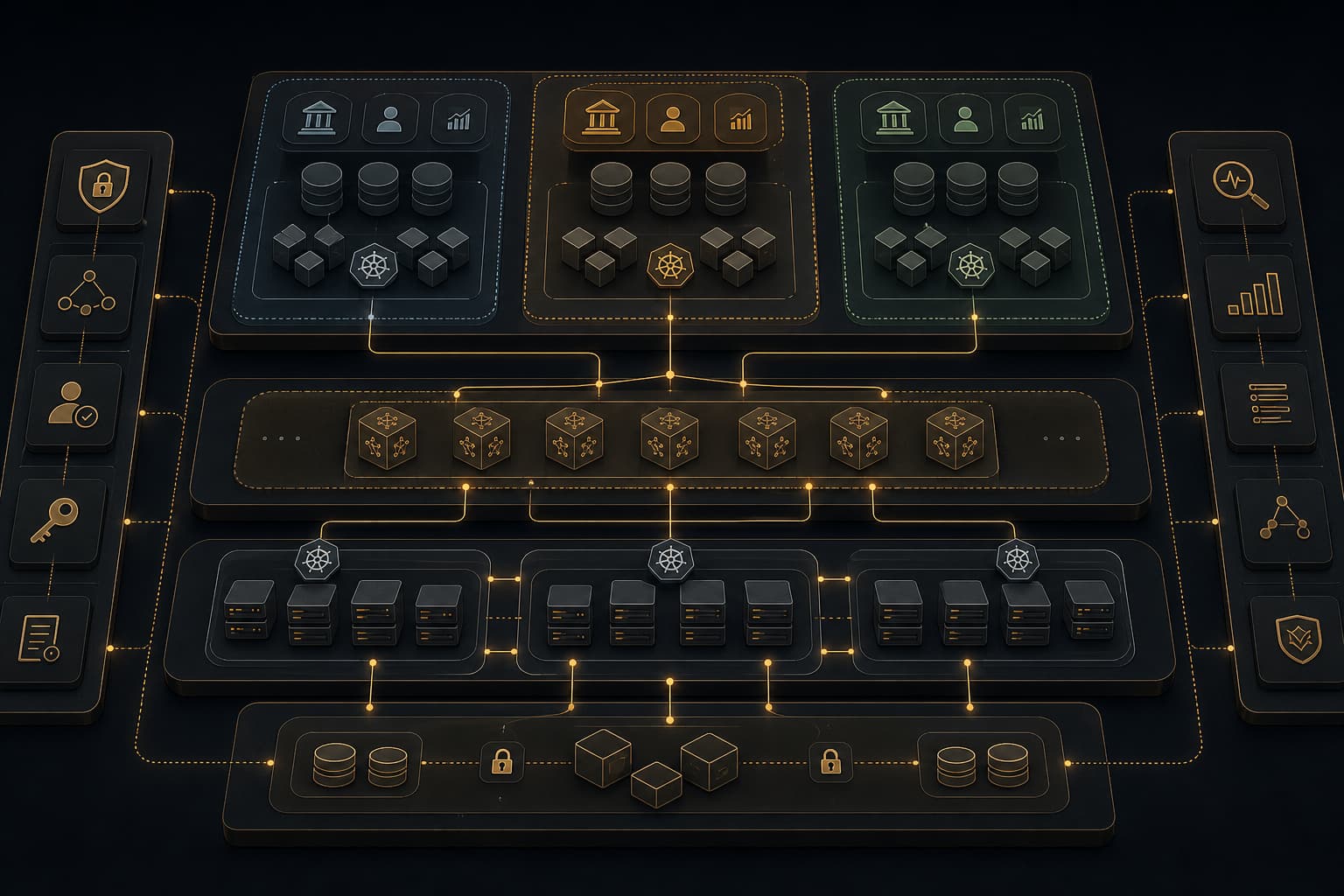
On 3 September 2026, VMware announced general availability of VMware Cloud Foundation 9.1.1. The release is not just another platform increment. VMware is positioning VCF as the operating layer for private AI: multi-tenant model sharing, Kubernetes add-on management, expanded operations visibility, security hardening and AI-assisted infrastructure workflows are now part of the same private cloud conversation.
For Luxembourg fund managers, AIFMs, private banks and enterprise IT teams, the signal is clear: AI infrastructure is moving out of isolated innovation labs and into the regulated production estate. That changes the decision from “which model do we use?” to “which control plane governs the model, the tenant, the data, the runtime and the evidence?” Under DORA, CSSF expectations and GDPR, that distinction matters. A private AI deployment without recoverability, observability, identity boundaries and audit-grade operational evidence is not sovereign infrastructure. It is another undocumented critical service.
Regulatory & Business Impact
The business value of VCF 9.1.1 is not only in VMware’s feature list. The bigger point is that a major infrastructure vendor is now packaging private cloud, Kubernetes operations and AI workload governance as one executive buying decision. Broadcom introduced VMware Private AI Cloud at VMware Explore 2026 as a way to run inference workloads, agentic applications and traditional enterprise workloads together on a private cloud platform. ITPro’s coverage framed the move around AI cost drivers and infrastructure consolidation, which is exactly the pressure many European CIOs are facing: public-cloud AI consumption is fast to start, but difficult to forecast, contain and evidence once it enters production.
For regulated financial entities, this intersects directly with DORA. If an AI workload supports risk reporting, client servicing, trading operations, fund operations, cybersecurity analysis or incident response, it cannot be treated as a sidecar experiment. It becomes part of the ICT risk management perimeter. That means clear ownership, incident classification, third-party dependency mapping, resilience testing, access governance and exit planning.
Luxembourg firms should read this release through three lenses.
First, data sovereignty. Private AI reduces exposure to uncontrolled external processing, but it does not automatically solve sovereignty. A model running inside a VMware estate still needs strict tenant isolation, retention controls, prompt and output handling rules, encryption, key ownership and evidence of where inference actually occurred.
Second, operational resilience. DORA is pushing boards and management bodies to understand technology dependency chains. AI inference adds new chains: GPU scheduling, model registries, vector databases, Kubernetes clusters, API gateways, observability pipelines, backup domains and identity providers. If one of those fails during a regulatory reporting window or client-impacting incident, “the AI platform was down” is not an acceptable root cause.
Third, cost containment and vendor concentration. VMware remains deeply embedded in European enterprise infrastructure. VCF 9.1.1 may be attractive for organisations already standardized on VMware, especially where platform teams want a supported route to private AI without rebuilding everything on day one. But leaders should still compare the full economics against alternatives: Proxmox plus Ceph, OpenShift Virtualization, Nutanix AHV, bare-metal Kubernetes, vLLM, Ollama, Qdrant and open observability stacks. The correct answer is not ideological. The correct answer is the one that reduces operational risk, proves compliance and survives renewal cycles.
Architectural & Operational Blueprint
A regulated private AI platform should be designed as a controlled production service, not as a GPU island.
At the edge, route model and agent traffic through a governed ingress layer: F5, Nginx, HAProxy, API gateway or service mesh depending on the estate. This layer should enforce TLS policy, tenant routing, request limits, authentication, network segmentation and logging. It is also where financial institutions can apply allowlists, WAF policies and explicit separation between human users, applications and agents.
Behind that, the AI runtime should be isolated by workload class. Low-risk internal summarisation should not share the same execution trust zone as an agent that can query operational systems, open tickets or trigger automation. Whether the platform is VCF Private AI Services, Kubernetes with vLLM, Ollama for smaller local models, or a hybrid pattern, each workload should have a declared owner, data classification, model source, retention profile and operational support model.
For retrieval-augmented generation, vector stores such as Qdrant must be treated as regulated data platforms. Indexes contain derived representations of sensitive material. They need access controls, backup policies, lifecycle management and deletion workflows aligned with GDPR and internal records policies. Treating embeddings as harmless metadata is a mistake.
For operations, the important layer is evidence. VCF 9.1.1’s emphasis on private cloud operations and Kubernetes observability reflects a practical truth: AI platforms fail in ordinary infrastructure ways. DNS breaks. certificates expire. ingress rules drift. storage latency increases. GPU nodes run hot. Kubernetes upgrades affect scheduling. If you cannot correlate inference latency, pod events, node pressure, reverse proxy logs, identity decisions and user impact, the platform will not stand up well during an incident review.
This is where Zabbix, Grafana, Prometheus, OpenTelemetry and log pipelines become part of the compliance architecture. They should produce a timeline that management, engineering and auditors can understand. For higher-risk AI agents, every tool call should be attributable to a human, service account or approved workflow. Every privileged action should have a policy decision attached to it. Every automated remediation should be reversible or at least bounded by a controlled change path.
Automation must be designed with the same discipline. Ansible, Terraform and GitOps can reduce drift, but only when tied to approval workflows and environment separation. A private AI platform should have defined promotion paths from development to test to production. Model updates, container image updates, Kubernetes add-ons and GPU driver changes should pass through release gates. “The model changed last night” should never be discovered during a client incident.
What This Changes in Practice
- Boards should ask for an AI infrastructure dependency map. Include hypervisors, Kubernetes clusters, model runtimes, vector stores, gateways, IAM, backups, monitoring and third-party providers.
- CIOs should separate private AI strategy from VMware renewal strategy. VCF may be a strong fit for existing estates, but the business case must include lock-in, support, exit options and open-source alternatives.
- CISOs should classify AI agents as identities, not scripts. Agents that access systems need scoped credentials, runtime monitoring, approval gates and revocation paths.
- Infrastructure teams should define AI workload tiers. Not every model needs the same HA, GPU capacity or compliance controls. Critical workloads need stronger resilience patterns.
- Platform teams should make observability mandatory before production. Inference metrics alone are insufficient. Correlate application, Kubernetes, storage, network, security and user-impact telemetry.
- Fund operations leaders should identify where AI touches regulated processes. NAV support, reporting, reconciliations, client communications and risk workflows need explicit governance.
- Procurement should demand evidence portability. Logs, configurations, model inventory and incident timelines should remain usable if the firm changes vendor or architecture.
How Ali Run AIOps Approaches This
Ali Run AIOps treats private AI as a resilience and governance programme, not a product installation. In a regulated environment, the architecture has to connect infrastructure, security, automation and evidence. That means designing the control plane before scaling the GPU estate: ingress, segmentation, identity, observability, backup, release management and operational runbooks.
Our work sits at the intersection of Linux infrastructure, DevOps/SRE, sovereign AI and FinTech operations. For clients evaluating VMware Cloud Foundation, Proxmox, Kubernetes-based inference, vLLM/Ollama, Qdrant, Zabbix/Grafana or Ansible automation, the goal is the same: reduce operational risk, keep sensitive data under control, and build systems that can be explained under pressure. Private AI only creates business value when it is reliable enough for production and governed enough for audit.
Sources
- VMware Cloud Foundation Blog — Announcing General Availability of VMware Cloud Foundation 9.1.1
- VMware Cloud Foundation Blog — New AI and Kubernetes Private Cloud Operations Capabilities in VCF 9.1.1
- Broadcom — VMware Private AI Cloud announcement
- ITPro — VMware targets AI cost drivers with new Private AI Cloud service
- CSSF — ICT and cyber risk for DORA entities
- CSSF — Circular CSSF 25/882 on ICT third-party services under DORA
Related Notes
Cloud & Virtualization · Aug 27, 2026
Kubernetes 1.37 makes AI clusters auditable
Kubernetes 1.37 turns AI clusters into resilience evidence: scheduling, metrics, identity and upgrade hygiene now matter.
Cloud & Virtualization · Sep 5, 2026
Proxmox gets a serious Horizon VDI route
Proxmox’s Horizon certification makes open virtualization a more credible VDI option for regulated European firms.