
Sovereign AI · August 26, 2026
Cisco’s rack-scale AI factory raises sovereignty bar
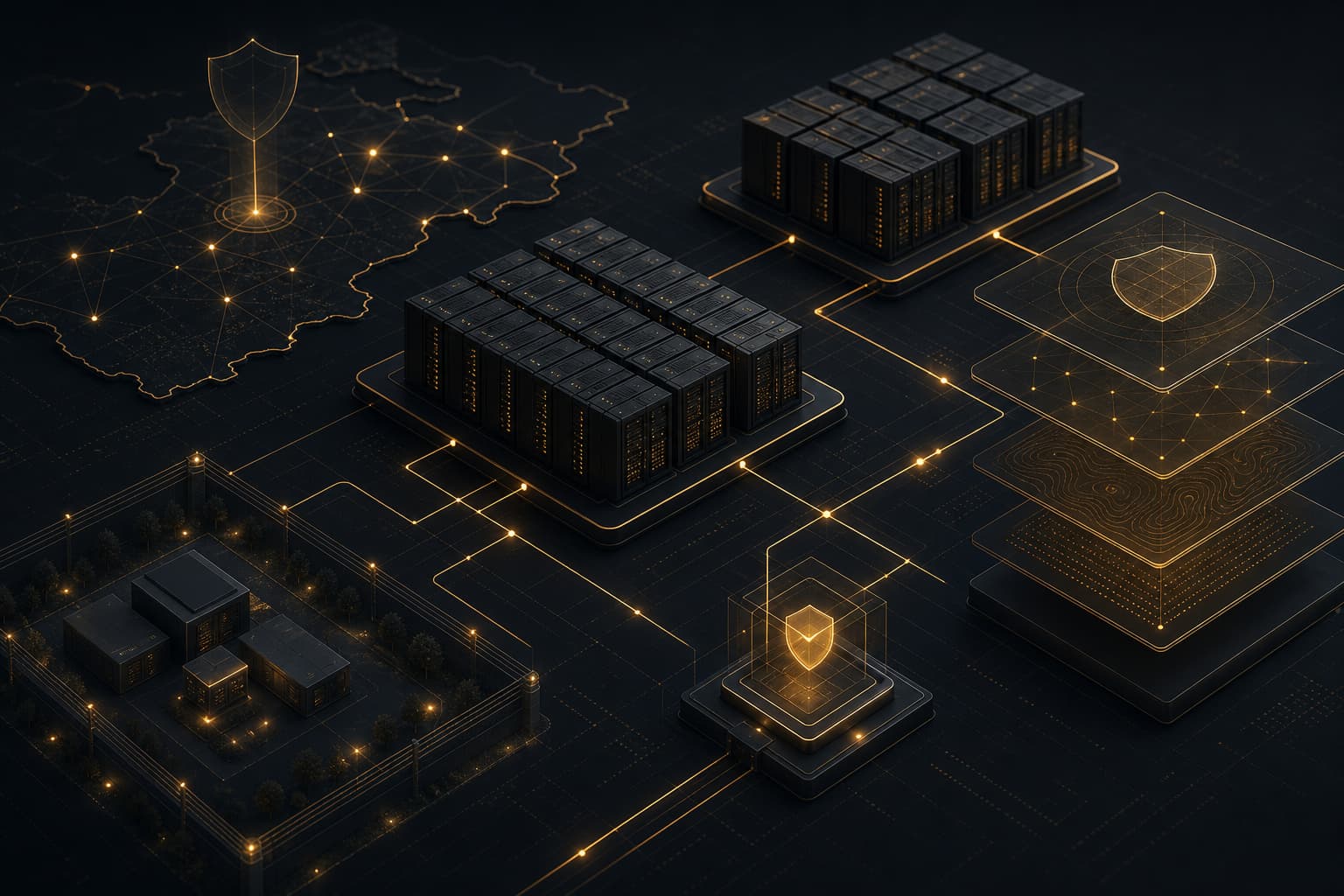
Cisco’s 25 August 2026 expansion of Secure AI Factory with NVIDIA is not just another AI hardware bundle. The material point is that Cisco is adding Supermicro high-density liquid- and air-cooled compute into a full-stack architecture aimed at enterprise, neocloud and sovereign cloud deployments, with ordering expected from October 2026. The Cisco FAQ describes a rack-scale NVIDIA Cloud Partner reference architecture built around Cisco AI networking, distributed security, Splunk observability, Supermicro NVIDIA NVL72/HGX/MGX systems, NVIDIA AI Enterprise software, storage partners and Kubernetes platforms.
For Luxembourg fund managers, AIFMs, private banks and regulated FinTech operators, this is a useful market signal. AI infrastructure is moving from experimental GPU islands into managed, validated, audited data-centre architecture. That matters because European firms now have to reconcile three pressures at once: AI adoption by the business, EU AI Act transparency and governance expectations, and DORA-style operational resilience for the infrastructure that will increasingly support critical processes.
Regulatory & Business Impact
The strategic question is no longer whether an enterprise can buy GPUs. The harder question is whether the organisation can operate AI capacity with the same discipline it applies to payment platforms, fund operations, trading risk systems and identity infrastructure.
That is why this announcement is relevant beyond Cisco customers. It confirms that the AI infrastructure market is being packaged around validated designs, observable fabrics and controlled deployment paths. In regulated Europe, that packaging is valuable only if it reduces evidence gaps. A Luxembourg financial entity does not simply need “AI performance”. It needs to show where data flows, who administers the stack, which third parties are involved, what telemetry exists, how incidents are detected, and how the service can be recovered or exited without operational paralysis.
DORA makes this framing unavoidable. CSSF guidance for DORA entities emphasises ICT risk management, digital operational resilience testing, ICT third-party arrangements and the register of information for ICT services. When AI platforms become part of decision support, customer operations, cyber defence, software engineering or fund operations, they should be treated as governed ICT services rather than innovation sandboxes. The same applies if the model endpoint is private, hybrid or hosted by a provider in a so-called sovereign cloud.
The EU AI Act adds another layer. The Commission’s enforcement framework states that AI Office and national authority enforcement powers apply from 2 August 2026 for certain provisions, including obligations for providers of general-purpose AI models and transparency requirements. Even when a bank or fund manager is “only” a deployer, procurement and architecture teams need contractual, technical and logging controls that support downstream accountability.
From a business point of view, the Cisco/NVIDIA/Supermicro move also pressures the build-versus-buy conversation. Validated AI infrastructure can reduce integration risk, but it can also increase vendor concentration if executives treat the reference architecture as a substitute for internal control design. In FinTech, concentration risk is not theoretical. VMware licensing changes, hyperscaler dependency, GPU scarcity and managed AI retention policies have already taught the same lesson: cost, exit and compliance must be designed before production dependency forms.
Architectural & Operational Blueprint
A sovereign AI platform for a regulated European enterprise needs more than a rack of accelerators. It needs a control plane that can survive audit, incident response and commercial renegotiation.
At the bottom layer, the physical and virtual infrastructure should be segmented by workload class. Training, fine-tuning, batch inference and interactive agentic workloads have different blast-radius profiles. High-throughput inference for internal knowledge systems may sit closer to business data, while experimentation should remain isolated. Whether the substrate is Cisco/NVIDIA, Proxmox/KVM, VMware Cloud Foundation, Kubernetes bare metal or a hybrid model, the design principle is the same: separate trust zones, define data paths, and keep privileged administration narrow.
The network fabric is where many AI projects become operationally fragile. GPU clusters need east-west bandwidth, but regulated workloads also need inspection points, policy enforcement and reliable telemetry. A mature pattern is to combine high-performance AI networking with explicit ingress and egress control: F5 or Nginx reverse proxies for API exposure, private DNS, mTLS between services, rate limits, model gateway policies, and central logging. This is also where data-loss controls and tenant segmentation become practical rather than aspirational.
The inference layer should be selected with data classification in mind. Some use cases can safely consume external APIs with strict contractual controls and retention settings. Others belong on private inference stacks using vLLM, Ollama or vendor-supported NVIDIA AI Enterprise components, depending on performance and support requirements. For RAG systems, vector databases such as Qdrant should be deployed with the same backup, encryption, access control and lifecycle discipline as databases holding regulated business records.
Agentic workflows need a separate governance layer. LangGraph-style orchestration can be powerful, but agents that touch ticketing, code repositories, firewalls, fund documents or customer workflows must run through approval gates. Tool calls should be logged. Secrets should never be exposed to prompts. Human approval should be mandatory for state-changing operations. The correct executive KPI is not “number of agents deployed”; it is the reduction of operational toil without creating unbounded automation risk.
Observability then ties the architecture together. Cisco is explicitly positioning Splunk observability in the stack; many European estates will also run Zabbix, Grafana, Prometheus, OpenTelemetry and SIEM platforms. The important point is correlation: model latency, GPU saturation, network errors, token cost, failed tool calls, authentication anomalies and business-service impact must be visible in one incident narrative. DORA-era resilience requires evidence, not screenshots collected after the outage.
Finally, automation should be treated as a control. Ansible playbooks, GitOps pipelines and immutable configuration baselines give infrastructure teams repeatability across GPU nodes, Kubernetes workers, reverse proxies, storage and monitoring agents. In practice, this is what turns a sovereign AI platform from a one-off build into an operating model.
What This Changes in Practice
- AI procurement becomes infrastructure governance. Buying a validated stack is useful, but legal, risk, security and operations teams still need evidence of data residency, subcontractors, logging, access control and exit options.
- Reference architectures should be mapped to DORA controls. Treat AI platforms as ICT services with resilience testing, dependency registers, incident reporting paths and recovery objectives.
- Observability must include AI-specific signals. GPU health, inference latency, queue depth, token usage, model gateway decisions and agent tool calls should be correlated with business-service monitoring.
- Sovereignty is not only geography. Data location matters, but so do administrative access, encryption keys, model supply chain, support paths, telemetry export and the ability to run critical workloads without a single provider bottleneck.
- Private inference should be tiered. Not every workload requires rack-scale liquid-cooled infrastructure. Many regulated use cases start with controlled on-premise inference, smaller open models, RAG, and strict workflow boundaries.
- Agentic automation needs approval gates. For infrastructure and fund operations, autonomous action without change control is a resilience liability.
- Cost models must include power, cooling and utilisation. Rack-scale AI changes facilities planning. ROI depends on shared platforms, workload scheduling and disciplined consumption controls.
How Ali Run AIOps Approaches This
Ali Run AIOps treats sovereign AI as an infrastructure and operations discipline, not a branding exercise. The starting point is a clear map of business services, data classes, regulatory exposure and existing platforms: Linux, virtualization, storage, network edge, IAM, monitoring and automation. From there, we design AI capability that fits the operating reality of Luxembourg and European regulated firms.
Practically, that means resilient Linux and virtualization foundations, private inference where data sensitivity requires it, reverse-proxy and network segmentation patterns, Qdrant-backed knowledge systems, LangGraph-style controlled agents, Ansible automation, and Zabbix/Grafana evidence pipelines. The objective is simple: make AI useful to the business without weakening DORA readiness, CSSF expectations, GDPR posture or operational control.
Sources
- Cisco newsroom: Cisco Expands Secure AI Factory with NVIDIA for the Rack-Scale Era
- Cisco FAQ: Expansion of Cisco Secure AI Factory with NVIDIA to Rack-Scale Architecture
- Network World: Cisco bulks up AI infrastructure portfolio with Supermicro liquid-cooled servers
- European Commission: The enforcement framework of the AI Act
- CSSF: ICT and cyber risk for DORA entities
- EBA: ESAs call for enhanced governance and consistent supervision to mitigate ICT risks from frontier AI models
Related Notes
Sovereign AI · Sep 7, 2026
Luxembourg Open-Source AI Assessment Sandbox Configurator
Luxembourg's LIST and SnT release an open-source sandbox configurator to standardize EU AI Act and DORA compliance testing for enterprise AI.
Sovereign AI · Sep 2, 2026
Frontier AI privacy moves into customer custody
Anthropic’s new safeguards make frontier AI a custody architecture problem for regulated European firms, not just a vendor policy choice.