
Sovereign AI · August 31, 2026
AI sovereignty now has a funding dependency
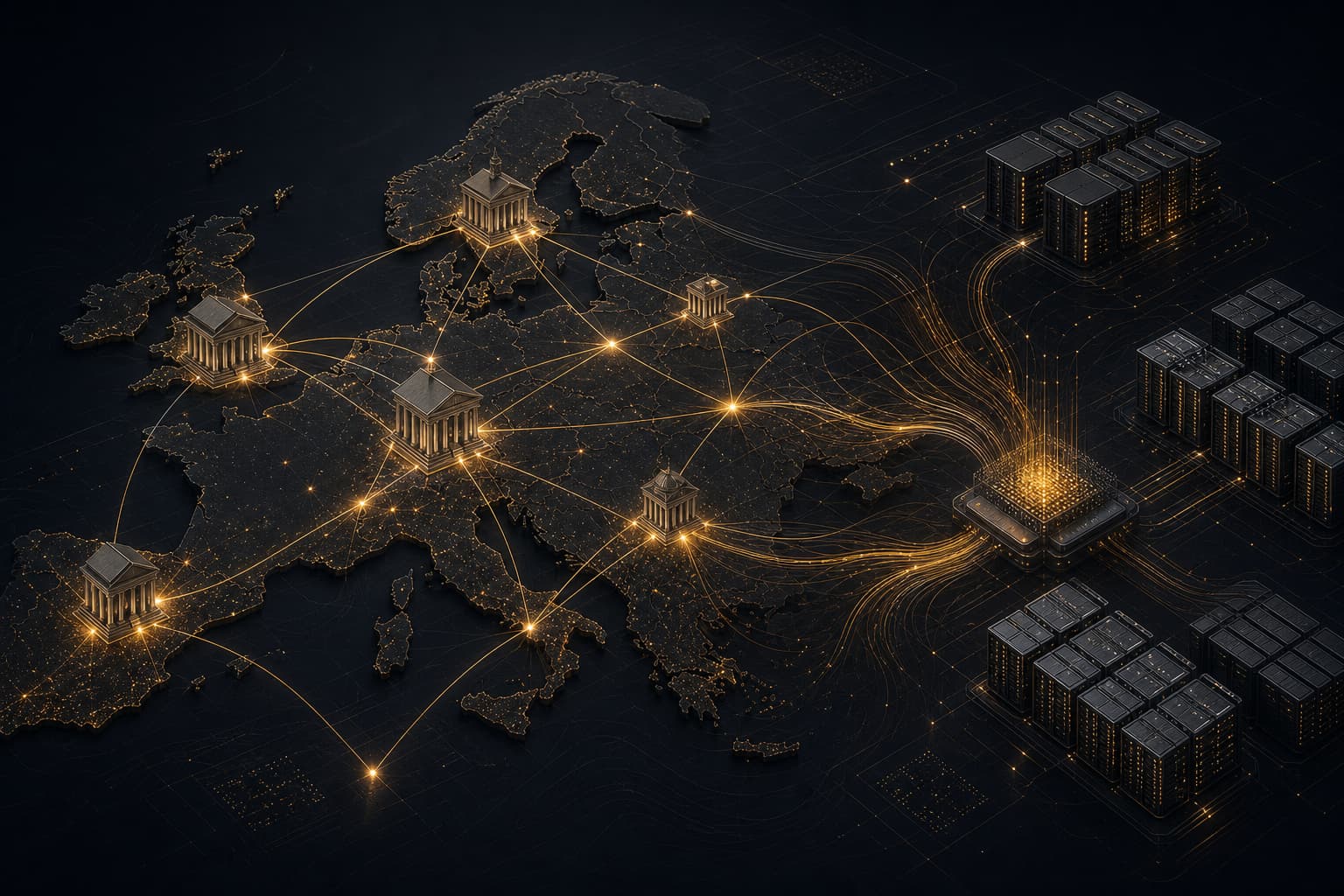
On 31 August 2026, the ECB Blog put a financial-market frame around a subject many technology teams still discuss as if it were only a data-centre problem: US hyperscalers are increasingly tapping the euro area corporate bond market to fund the AI infrastructure buildout. The ECB notes that Google, Amazon and Microsoft operate massive cloud and AI infrastructure, that hyperscalers are projected to need more than USD 1 trillion of capital expenditure by 2028, and that euro-denominated borrowing has become part of that funding model.
For Luxembourg and European financial institutions, this is not a remote capital-markets curiosity. It changes how we should think about sovereign AI, cloud concentration and operational resilience. The same providers that already sit inside payment systems, fund operations, risk analytics, document processing, identity stacks and data platforms are now using European credit markets to finance the compute layer that European enterprises will later consume. Sovereignty is no longer only about where data sits. It is also about who owns the infrastructure, who finances it, how concentrated the dependency becomes, and whether regulated firms can prove credible alternatives when cost, capacity or policy changes.
Regulatory & Business Impact
The confirmed news is financial: the ECB says US big tech companies now represent just under 10% of gross new issuance of euro-denominated bond debt attributable to non-financial corporations, with around €40 billion of euro-denominated hyperscaler bonds outstanding in relevant benchmark indices. The ECB also says Amazon and Alphabet have been the largest issuers in the euro area non-financial corporate bond market this year, with Amazon setting an all-time transaction-size record.
The strategic implication is operational: Europe is helping finance an AI infrastructure layer that remains heavily controlled by non-European hyperscalers. That may be economically rational for investors, but it creates a sharper question for CIOs, CISOs and boards in regulated sectors. If your AI roadmap depends on the same few cloud platforms for GPUs, storage, model APIs, identity, observability and managed security tooling, then concentration risk is not theoretical. It is embedded in architecture, procurement and balance-sheet exposure.
DORA already forces financial entities to manage ICT third-party risk, resilience testing, incident reporting, business continuity and exit planning. The AI funding wave adds another dimension: critical ICT providers are not merely technology suppliers; they are infrastructure-finance actors with investment cycles, debt maturities, capex pressure and monetisation assumptions. If the AI buildout disappoints, becomes more expensive, or shifts toward higher-margin services, European customers may see price pressure, product bundling, regional availability constraints or contract terms that reduce flexibility.
S&P Global Ratings made a similar credit-risk point shortly before the ECB blog, stating that combined hyperscaler capex is projected to exceed USD 1.3 trillion by 2027 and that debt, leases, guarantees and other financing structures are becoming more important in funding AI infrastructure. Vanguard also warned that AI-linked borrowing is changing the character of bond markets, with technology concentration moving into an asset class traditionally used for diversification.
For Luxembourg fund managers, AIFMs, private banks and regulated service providers, this matters in three ways. First, vendor concentration must be measured across the AI stack, not only cloud hosting. Second, cost-control models need to assume that GPU-backed services may not follow the historical cloud-pricing curve. Third, sovereignty claims must be tested operationally: contractual data residency is not enough if inference, embeddings, monitoring, backup, key management and incident response remain tied to a single foreign platform.
Architectural & Operational Blueprint
The answer is not to reject hyperscalers. That would be simplistic and commercially unrealistic. The answer is to design for controlled dependency.
A credible European AI architecture should separate five layers: data control, model execution, orchestration, observability and exit capability. Each layer needs an owner, a policy, a failure mode and a migration path.
At the data layer, regulated firms should classify what can leave the institution, what must stay inside Luxembourg or the EU, and what must remain on-premise or inside a dedicated sovereign cloud boundary. Client records, fund documents, portfolio instructions, KYC evidence, incident records and privileged infrastructure telemetry should not be casually pushed into black-box AI workflows. GDPR, CSSF expectations and DORA evidence requirements all push in the same direction: know the data path and be able to prove it.
At the model-execution layer, use a tiered pattern. Public frontier APIs can be appropriate for low-risk productivity and generic analysis. But sensitive inference should have a private option: vLLM or Ollama for controlled on-premise inference, GPU-backed Kubernetes where justified, or Proxmox-based virtualisation for smaller sovereign deployments where cost discipline matters. The point is not to pretend every firm can run a hyperscale model. The point is to maintain a working private inference lane for high-sensitivity workflows and continuity planning.
At the orchestration layer, agentic systems need guardrails before scale. LangGraph-style workflows, approval gates, tool allow-lists, deterministic retrieval, and explicit human-in-the-loop controls are more important than model choice. An AI agent that can call ticketing systems, shell tools, knowledge bases, document stores or payment-adjacent workflows is part of the control plane. Treat it like privileged automation, not like a chatbot.
At the retrieval layer, keep enterprise memory under enterprise control. Qdrant or equivalent vector search can support internal knowledge retrieval without outsourcing every embedding, query and document chunk to a hyperscaler. For financial operations, retrieval design should include source attribution, retention rules, index rebuild procedures, encryption, tenant boundaries and rollback capability.
At the edge and access layer, do not forget the boring infrastructure. Reverse proxies, F5 or Nginx policy enforcement, mTLS, SSO, rate limiting, egress controls and WAF telemetry remain essential. Sovereign AI still runs on networks, certificates, DNS, storage, queues and Linux systems. Most incidents start in these layers, not in a board presentation.
At the observability layer, AI workloads need the same evidence discipline as core banking and fund operations. Zabbix, Prometheus, Grafana, SIEM pipelines and immutable logs should cover GPU utilisation, model latency, failed tool calls, rejected actions, retrieval misses, policy denials, token spend, data movement and human approvals. If a regulator asks how an AI-assisted operational decision was made, the answer cannot be “the platform handled it”.
Finally, exit planning must be real. A PowerPoint exit strategy is not a DORA control. Run restore tests, model-fallback tests, retrieval reindexing tests, API-failover tests and manual-operation drills. Keep Infrastructure-as-Code portable where possible. Use Ansible and Terraform carefully, with provider abstractions only where they do not hide critical differences. Maintain a minimum viable private AI service that can support priority workflows during supplier disruption or commercial renegotiation.
What This Changes in Practice
- Boards should ask for AI dependency maps, not only cloud spend reports. Map model providers, GPU providers, vector databases, identity integrations, observability, backup and support contracts.
- CIOs should review concentration risk through DORA, especially where the same hyperscaler supports hosting, AI APIs, security tooling and disaster recovery.
- CFOs should challenge AI unit economics. Token cost is only one line. Include GPU reservation, data egress, storage growth, observability volume, vendor support and exit cost.
- CISOs should treat AI agents as privileged automation. Tool access, approval gates, audit logs and blast-radius controls must be designed before production use.
- Fund operations leaders should protect document workflows. KYC, NAV support, investor communications and risk reporting need traceable AI use, not opaque document upload habits.
- Architecture teams should maintain a private inference lane. Even a limited on-premise model capability can materially reduce operational and negotiation risk.
- Procurement should demand portability evidence. Ask vendors how embeddings, prompts, logs, fine-tuning artefacts, vector indexes and workflow definitions are exported and deleted.
- Engineering teams should test failure modes quarterly. Assume model API outage, degraded GPU capacity, identity failure, vector-store corruption and supplier access suspension.
How Ali Run AIOps Approaches This
Ali Run AIOps looks at sovereign AI as infrastructure engineering, not theatre. The work starts with dependency mapping, Linux and virtualisation hygiene, network control, observability, automation and evidence. A useful AI system for a regulated business must survive audits, outages, supplier pressure and ordinary operational mistakes.
Our consulting approach combines resilient infrastructure design with practical private AI patterns: Proxmox or Kubernetes where appropriate, vLLM or Ollama for controlled inference, Qdrant for governed retrieval, Nginx or F5 for access control, Ansible for repeatable operations, and Zabbix/Grafana for measurable resilience. The objective is not to avoid every external platform. The objective is to make dependency intentional, documented, tested and commercially defensible.
Sources
- ECB Blog: Big tech, big debt — when US tech giants tap the euro area bond market
- Vanguard: The AI buildout comes to the bond market
- Goldman Sachs: Global AI investment is forecast to exceed $1 trillion in 2026
- S&P Global Ratings: AI infrastructure investment to exceed $1.3 trillion by 2027
- Morningstar UK: How Amazon and Alphabet are borrowing billions in Europe for AI
- European Commission: Guidelines on AI Act transparency obligations
Related Notes
Sovereign AI · Aug 29, 2026
AI watermarking becomes enterprise evidence
EU AI Act transparency is now operational. AI output marking must become part of enterprise governance, not a legal footnote.
Sovereign AI · Aug 26, 2026
Cisco’s rack-scale AI factory raises sovereignty bar
Cisco’s NVIDIA/Supermicro expansion shows sovereign AI is now a governed infrastructure programme, not a lab GPU purchase.