
DORA & Resilience · August 27, 2026
CSSF brings third-country branches into DORA
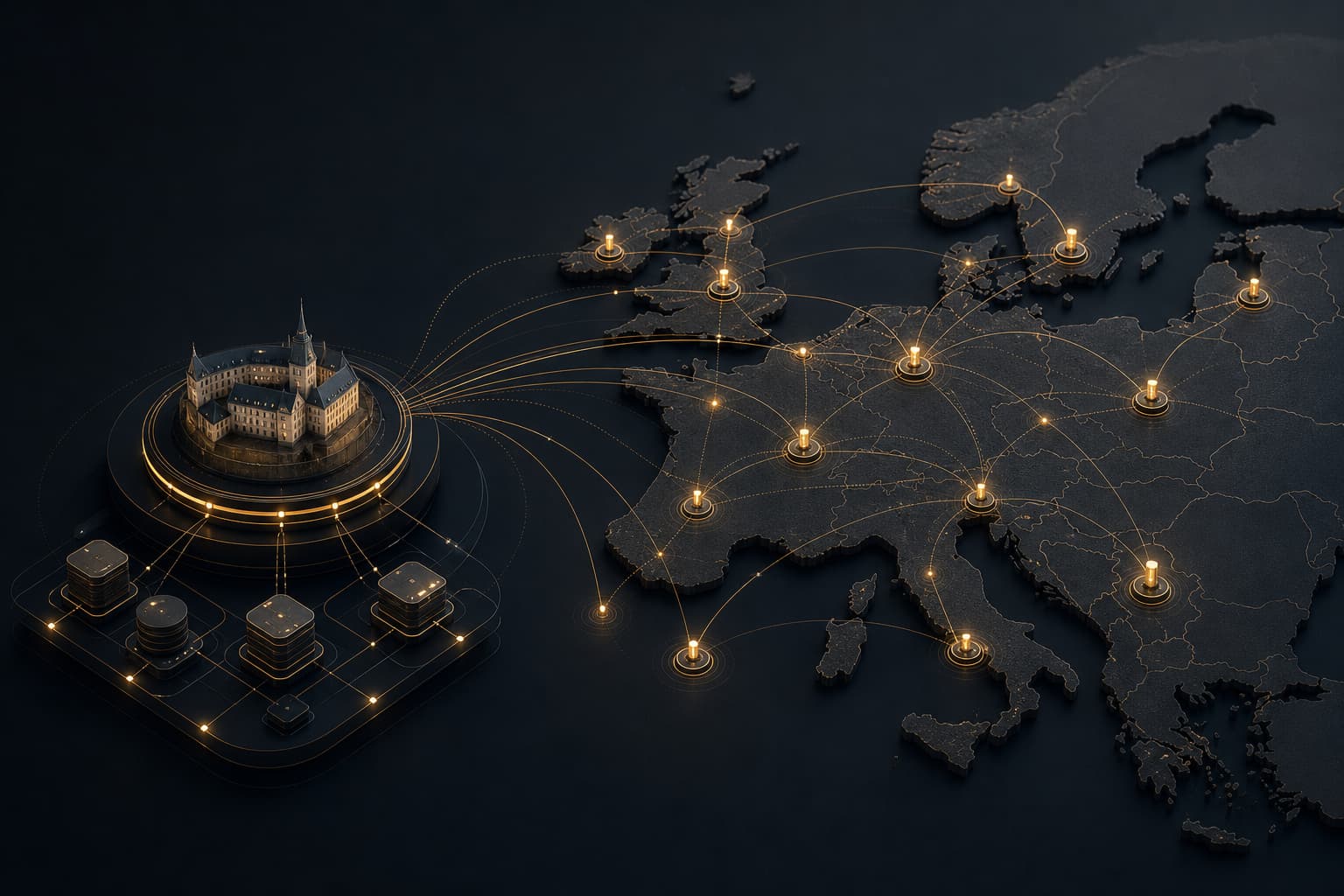
On 27 August 2026, the CSSF published a Luxembourg-specific DORA update that deserves board-level attention from banks, investment firms, insurers, payment institutions and cross-border groups operating through third-country branches. The message is direct: third-country branches in Luxembourg are being brought into the local DORA circular perimeter, following the European Commission’s DORA Q&A position that the Regulation applies to third-country branches in an EU country where the relevant head office would qualify as a DORA financial entity.
This is not a paperwork-only clarification. For Luxembourg entities connected to non-EU headquarters, shared platforms, group SOCs, managed service providers, global cloud contracts or centralised incident processes, the branch can no longer be treated as an operational footnote. The practical question becomes: can the Luxembourg branch produce its own evidence of ICT risk management, third-party dependency control, incident reporting, exit planning and resilience testing — even where much of the infrastructure is owned, operated or contracted outside Luxembourg?
Regulatory & Business Impact
The CSSF communiqué states that DORA has applied since 17 January 2025 to financial entities supervised by the CSSF, and that the European Commission confirmed through official DORA Q&A 102 that DORA also applies to third-country branches in an EU country when the head-office entity would fall within DORA’s Article 2 scope. As a result, the CSSF has updated a series of circulars to include third-country branches in the DORA scope.
The most important operational change is the migration of these branches away from legacy Luxembourg ICT and outsourcing treatment into the DORA-specific rule set. The CSSF says Circular CSSF 26/915 removes third-country branches from parts of Circular CSSF 20/750 on ICT and security risk management and Circular CSSF 22/806 on outsourcing. It then includes them in Circular CSSF 25/882 on ICT third-party services for DORA entities, Circular CSSF 25/892 on annual aggregated costs and losses caused by major ICT incidents, and Circular CSSF 25/893 on reporting major ICT-related incidents and significant cyber threats.
For executives, that means the control objective is no longer simply “does the branch use group IT?” It is “can the branch demonstrate DORA-grade accountability for group IT?” That distinction matters for Luxembourg private banking desks, fund servicing platforms, AIFM operations, brokerage infrastructure, payment flows and risk systems that depend on non-EU parent platforms.
The business risk is concentrated in three areas.
First, incident reporting. If the prescribed CSSF communication channel cannot be used, the CSSF update adds a clarification around reporting major ICT-related incidents and significant cyber threats. This pushes firms to test supervisory communications as part of crisis management, not after an outage has already degraded identity, email, VPN, secure file transfer or case-management tooling.
Second, third-party ICT services. Circular CSSF 25/882 sits directly in the DORA third-party risk context. For a branch, the “third party” may not be a public cloud provider alone. It may be a parent-company shared service, a group data centre, a global managed SOC, a SaaS risk engine, a core banking platform, an outsourced NOC, or an AI inference environment hosted in another jurisdiction.
Third, cost and loss evidence. Circular CSSF 25/892 connects major ICT incidents to annual aggregated costs and losses. That is a finance and operations issue, not only a CISO issue. If the Luxembourg branch cannot separate local business impact from group-wide incident noise, management will struggle to provide credible supervisory evidence and meaningful internal ROI analysis for resilience investment.
The strategic reading is simple: DORA is becoming harder to outsource upward to the parent company. Luxembourg branch leadership must have local visibility, local runbooks and local evidence, even when architecture is global.
Architectural & Operational Blueprint
The architecture response should start with a branch-level DORA control map. Every critical or important function should be connected to the systems, identities, networks, data stores, providers and operational teams that support it. For Luxembourg financial entities, that usually means mapping front-office applications, fund operations workflows, payment rails, trading or risk systems, reporting tools, document platforms, market-data dependencies, KYC/AML systems and supervisory communication channels.
From there, the branch needs a dependency graph that is useful during an incident. A spreadsheet register is not enough. The register of information may satisfy a reporting format, but operations need a living model: which business process depends on which application, which application depends on which database, which database depends on which storage, which storage depends on which hypervisor, which hypervisor depends on which backup, and which access path depends on which identity provider, firewall, reverse proxy or VPN.
For a practical design, I would split the blueprint into five layers.
1. Resilient access and perimeter control. Put the branch’s critical access paths under explicit control: F5 or Nginx reverse proxies, hardened VPN, privileged access management, conditional access, certificate lifecycle monitoring, and clear break-glass procedures. If the group identity provider is unavailable, the branch must know which functions stop, which continue, and which are legally or operationally unacceptable to lose.
2. Observability with branch-level evidence. Zabbix, Prometheus, Grafana, SIEM telemetry and log pipelines should tag Luxembourg-relevant services and dependencies. The goal is not another dashboard. The goal is evidence: uptime, alert history, failed changes, backup success, replication lag, privileged activity, vulnerability exposure, and incident timelines that can be reconstructed without heroic manual work.
3. DORA-grade third-party and intra-group service control. Treat intra-group ICT services with the same seriousness as external providers. Maintain service descriptions, ownership, locations, subcontractor chains, recovery commitments, exit considerations and test evidence. Where VMware estates are part of the dependency chain, firms should also reassess licensing and concentration risk. Proxmox or other open infrastructure may reduce cost and improve control in some workloads, but only if HA, backup, patching, support and auditability are engineered properly.
4. Incident reporting resilience. Test the CSSF reporting path as an operational capability. If email, SSO, VPN or the standard portal is impaired, the branch needs an approved alternate route, named decision-makers, templates, time stamps, evidence capture, legal review boundaries and an after-action workflow. This should be integrated into crisis simulations, not left as a compliance PDF.
5. Sovereign and private AI controls. Many branches are already experimenting with AI for IT operations, policy search, incident summarisation and risk reporting. If those workflows touch logs, tickets, client metadata or regulated documents, private inference should be considered. A controlled stack using vLLM or Ollama, Qdrant for vector search, LangGraph-style approval flows, and strict data boundaries can support productivity without exporting sensitive operational evidence into unmanaged AI services.
What This Changes in Practice
- Branch management must own DORA evidence locally. Parent-company controls help, but the Luxembourg branch needs accessible proof, mapped to local critical functions.
- Intra-group IT becomes a supervised dependency. Shared services from a non-EU head office should be documented, monitored and tested like any other critical ICT provider.
- Incident communications need failover. If the prescribed channel cannot be used, the branch should already know the approved alternative and have rehearsed it.
- Registers must become operational tools. Static inventories should evolve into dependency graphs linked to monitoring, runbooks, owners and recovery objectives.
- Cost-of-incident reporting needs finance input. ICT incident loss estimation cannot be delegated entirely to infrastructure or security teams.
- Cloud and virtualisation strategy should be revisited. DORA strengthens the case for reducing avoidable concentration risk and for building credible exit options.
- AI operations need governance. AI-assisted incident response and documentation are useful only if prompts, logs, retrieval sources and approvals remain controlled.
How Ali Run AIOps Approaches This
Ali Run AIOps approaches DORA as an engineering and operating-model problem, not a binder exercise. For Luxembourg and European financial firms, the work starts by converting regulatory obligations into infrastructure evidence: service maps, dependency graphs, monitored controls, recovery tests, incident timelines, third-party registers and automation that management can actually rely on during pressure.
The consulting focus is resilient Linux and virtualisation platforms, secure automation with Ansible, observability with Zabbix and Grafana, reverse-proxy and network hardening, and sovereign AI patterns for private operational knowledge. For third-country branches, this combination is especially valuable: it gives local leadership visibility into global infrastructure, creates defensible evidence for CSSF expectations, and reduces the operational gap between compliance language and production reality.
Sources
- CSSF — Application of the Digital Operational Resilience Act (DORA) to third-country branches in Luxembourg
- CSSF — Circular CSSF 26/915
- EIOPA — DORA102-3097 Q&A on DORA application to third-country branches
- EBA — DORA102 single rulebook Q&A record
- EUR-Lex — Regulation (EU) 2022/2554, Digital Operational Resilience Act
Related Notes
DORA & Resilience · Aug 23, 2026
Entra ID CVSS 10 tests cloud identity resilience
A service-side Entra ID RCE fix is not enough for DORA-era finance. Evidence, telemetry and exit controls now matter.
DORA & Resilience · Sep 10, 2026
DORA Baseline Incident Report: Rethinking ICT Resilience
ESA data shows third-party failures outweigh cyberattacks. Discover how EU financial leaders must adapt DORA resilience strategies.